
Core Issue :
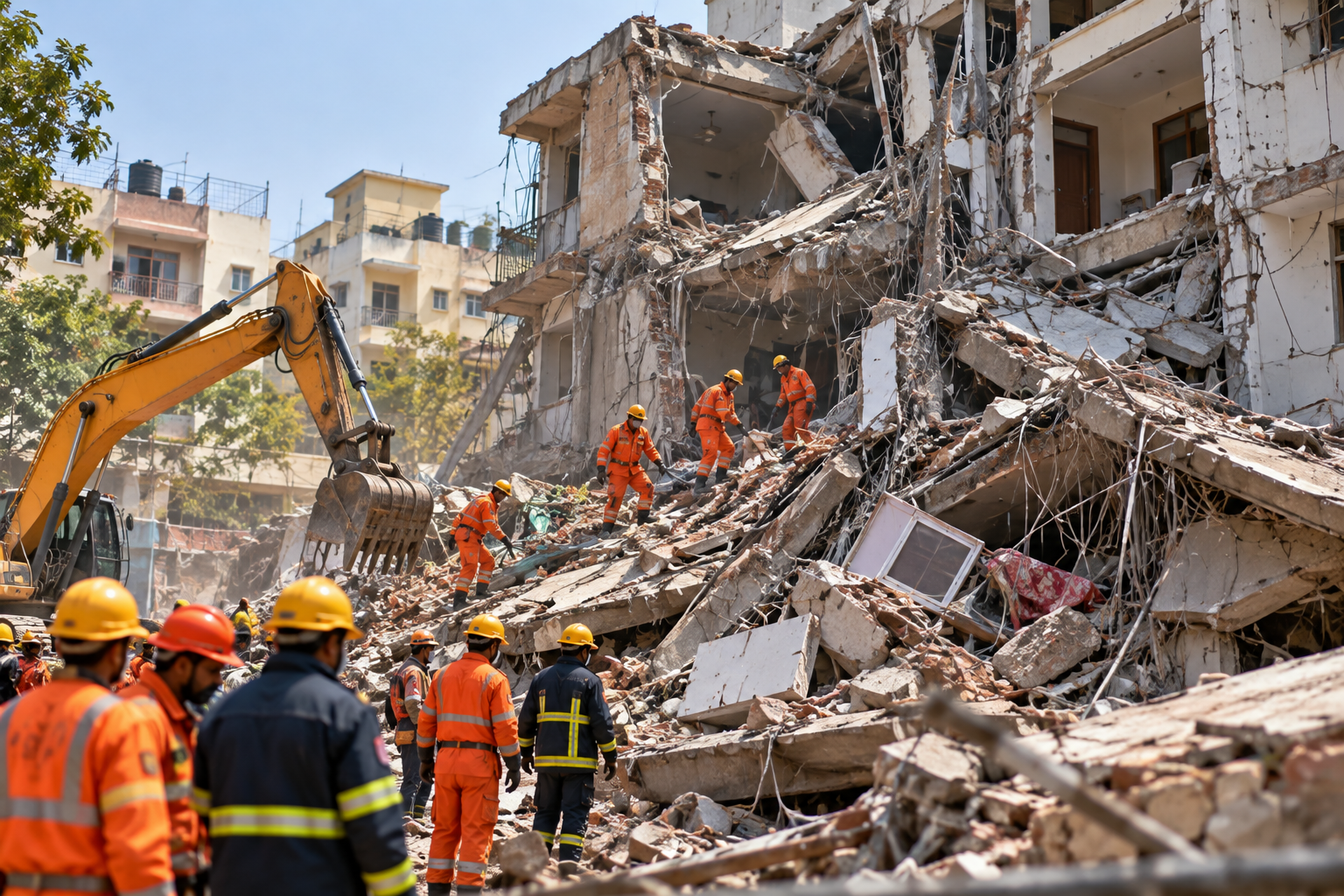
On 6 September 2026, a multi-storey building in Satya Niketan, South-West Delhi, near Delhi University’s South Campus, collapsed killing seven young students as the building was being used as a boys’ paying-guest accommodation. The problem appears broader as Delhi Fire Services recorded 76 house-collapse calls during January–May 2026, compared with 544 incidents in 2025 and 464 in 2024. Reports also indicate that 46 people died in building collapses during 2024–25.
This recent incident highlighted nationwide concern over infrastructure quality involving buildings, bridges, roads, flyovers and other public infrastructure with questions about structural safety, maintenance, quality control and enforcement. Government data cited from NCRB reports indicate that nearly 33,000 people died across India during 2020–2024 in incidents involving building collapses, fires, and falls into pits/manholes. Available national data show 21 bridge-collapse incidents in 2023 and 27 in 2024, killing at least 226 people in bridge-collapse incidents in the last one decade.
Time Line/Graph/Data :

Important Facts :
- Of the 1,435 structure-collapse incidents recorded in 2024, 922 involved dwelling houses/residential buildings. The 988 associated deaths represented almost two-thirds of all structure-collapse deaths.
- A 2025 Nature Sustainability study estimated that 2,406 buildings across Delhi, Mumbai and Chennai were at high risk of structural damage associated with ongoing land subsidence, based on satellite observations. CAG audits have identified wider systemic issues including inadequate planning, delays, contract-management weaknesses and incomplete safety provisions.
- And importantly, the Government itself has recognised the need for stronger structural-safety mechanisms. In July 2026, the Ministry of Housing and Urban Affairs announced a National Framework for Structural Safety Audits and Seismic Resilience of Buildings, while reiterating that building-plan approval and enforcement are primarily responsibilities of ULBs and development authorities.
- Most of the collapses are attributed to illegal constructions, aging infrastructure, and extreme weather events. Older buildings and bridges are increasingly being subjected to higher loads, alterations, traffic and changing environmental conditions without necessarily receiving proportionate structural assessments.
- Extreme weather increases stress on infrastructure: Heavy rainfall, flooding, erosion and waterlogging can expose weaknesses in buildings, bridges, roads and drainage systems.
WHAT INDIA EXPECTS
- A modern India cannot treat the collapse of a building as an unavoidable accident when warning signs, regulatory requirements and engineering safeguards can often identify risks beforehand.
- Older, high-occupancy and vulnerable buildings or bridges should undergo periodic structural assessment by qualified professionals, with transparent records of their safety status.
- Accountability needs to be fixed for stakeholders. For authorities, responsibility for approval, inspection, certification and enforcement should be clearly traceable.
- Use of technology needs to be promoted by authorities to perform real-time monitoring of geo-tagged inspections, digital building permissions, structural certificates, inspection records, complaint tracking, and automated alerts for violations.
- Construction worker safety protocols needs to be strictly enforced with rigorous supervision for site safety, temporary structures, excavation, scaffolding, shuttering and concrete works.
- The most important policy gaps to examine are therefore construction quality, independent structural inspection, maintenance funding, enforcement against unsafe/unauthorised construction, drainage and water-management, monitoring of ageing assets, and clear accountability when defects are identified.